The Body Always Knew Before I Did
Partager avec un ami
An Balla. The Wall.
It does not announce itself. You do not get a warning. One day you are going flat out and managing it, the next the body has made a decision you were not consulted on.
The territory of An Balla is familiar to anyone who has confused endurance with resilience for long enough. It is the place where the defences finally give, not because you failed, but because you succeeded at keeping going past every reasonable limit the body tried to set.
I know this territory. I lived in it for years before I understood where I was.
I was good at my job.
For most of my working life I thrived in environments that other people politely described as high pressure. Sales targets. Quarterly reviews. The particular satisfaction of closing something difficult. I liked the pace. I am built for it, genuinely, and I am not writing this to suggest I was not. Growing up in Clare there is a particular kind of work ethic that gets into you. I managed bars and nightclubs in my twenties, spent time out in Las Vegas, learned to move fast and make decisions without waiting to be told what to decide. The corporate world loves that. People who do not need managing. People who hit numbers.
People who turn up early and answer emails late and never once admit that any of it is taking a toll.
I was that person for a long time. I was also, though I would not have used the word, quietly in An Tost. The territory where the noise never stops even when the room is silent. The mind that will not let the body rest. The Friday night with a pint in front of me and my phone under the table because what if something comes in and I am the last to know.
The signs were there years before I saw them.
Lying awake at half two in the morning running through conversations I had already had, or ones I had not had yet. Getting snappy with people I genuinely liked. Treating weekends as maintenance periods rather than rest. Not recovery. Maintenance. Just enough to get through the next week before the whole thing started again.
I told myself this was normal.
The language we use around it does not help. Grinding. Hustle. Always on. Power through. These became badges of honour rather than warning signs. At some point in the last decade we collectively agreed that being exhausted was evidence of ambition. That burnout was just the price you paid for caring about your work.
I bought into it completely. Most people I know did.
What modern work culture is actually doing.
The system has become extraordinarily good at measuring human performance in ways that are invisible until you start looking. This call is recorded for training and quality purposes. Yes, and your screen idle time is logged. Your click volume is tracked. An algorithm somewhere is drawing conclusions about your productivity before your manager has looked up from their own screen.
Middle management sits in a uniquely uncomfortable position in all of this. Squeezed from above by growth targets that compound each quarter with no ceiling in sight, and aware in the background that the technology quietly doing parts of your job is not going to take a sick day or ask for a pay review. Nobody puts that on the agenda of the all-hands meeting. It is there though. In the background of every performance review. In the fine print of every policy update that arrives by email and gets signed and filed and never read again.
The fear is quiet. That is what makes it so corrosive.
In Ireland specifically, the numbers are not comfortable reading. 60% of Irish professionals reported suffering from workplace-related stress in a 2023 Robert Walters survey. 78% of Irish employees report at least one measurable impact of workplace stress on their health or behaviour. I was not special. I was entirely predictable. I just did not know it yet.
I had a simpler explanation for how I felt at the time. I was stressed, yes, but stress was the cost of doing meaningful work. I was tired, yes, but everyone was tired. I was irritable at home, yes, but once I got through this particular project, this particular quarter, this particular year, things would settle down.
They did not settle down. That is not how it works.
What the body is actually doing.
Chronic stress is not a mood. It is a physiological state. That distinction took me an embarrassingly long time to understand, and nobody in any workplace I worked in ever explained it to me directly.
The body responds to perceived threat through a cascade that starts in the hypothalamus, moves through the pituitary gland, and lands at the adrenal glands. Cortisol gets released. Heart rate increases. Blood is redirected. You sharpen up. The fight or flight response is a masterpiece of evolutionary engineering. In genuine danger it may save your life.
The problem is that the nervous system cannot reliably distinguish between a physical threat and an unreasonable email at eleven o'clock on a Friday night. When the perceived threat never fully resolves, when cortisol stays elevated week after week, month after month, the system begins to misfire. Immune response changes. Inflammatory markers shift. The body, doing its absolute best to protect you, starts to cause damage of its own.
I did not understand any of this at the time. I thought I was just stressed.
There is no such thing as just stressed.
What An Balla actually feels like.
In 2024 my body made a decision I had not been brave enough to make. My UC, ulcerative colitis, which I had been managing with varying degrees of success for years, flared in a way that removed any remaining pretence that I was managing anything at all. The gut is not a separate system that breaks down independently. It is one of the most accurate stress barometers in the body. When the nervous system has been in sustained high alert for long enough, the gut is one of the first places it becomes readable.
My body had been trying to tell me something for years. I had been very good at not listening.
An Balla is not a failure. That is the thing I want to be clear about. It is information. The most important information your body will deliver. The question it is asking is not whether you can push through it. I already knew I could push through things. That was the entire problem. The question it is asking is what you are going to do differently now that you know.
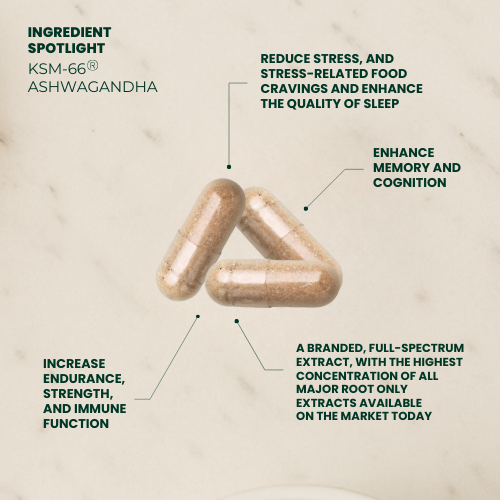
What I did differently was start paying attention to the conditions rather than managing the symptoms. Sleep as genuine restoration rather than unconsciousness. Recovery as a practice rather than something earned by finishing. And looking seriously at the nutritional conditions for a body under sustained stress, ashwagandha, which has traditionally been used to support the body's response to stress, vitamin C which contributes to normal immune system function, zinc which contributes to the normal function of the immune system, rather than reaching for something to override the signal rather than support the system sending it.
The body does not forget how to function. It simply stops having the conditions it needs to do so. Give it those conditions and it remembers.
That is what return looks like in An Balla. Not transformation. Not a new version of yourself. Just the original one, with the conditions it needed all along.
If this territory is familiar, BRÍ Immunity and BRÍ Calm were made for the stretch before An Balla and the return from it.
Mind yourself.
Glenn, Co-Founder, BRÍ Wellness.