The Inbox Never Empties. Your Body Is Keeping Score.
Share with a friend
An Balla. The Wall. This is the territory of the body that has been going too long. Not the moment of collapse. The long stretch before it, when the defences are running on fumes and the person inside them has no idea.
There is a place most people in this territory know well. It has no postcode. You will not find it on any map. But if you have spent a year, or two, or five, keeping everything running at the cost of your own actual functioning, you know exactly where it is. You know the geography of it better than you know your own town.
The work inbox at 6am before the world catches up. The Sunday evening that feels like the edge of something. The moment in a meeting when you realise you have not actually been present in twenty minutes and nobody noticed, which is either a relief or a small horror depending on the day.
You kept going. That is not a character flaw. That is the thing everyone who finds themselves in this territory has in common. They kept going. Not because they were unaware. Because stopping felt more dangerous than continuing, and somewhere along the way continuing became the only identity they had left.
This is a post about what happens in the body during that stretch. And it starts with a fairly embarrassing admission.
I was checking email during a conversation with Taylor.
We were sitting across from each other. She was talking. I was half listening, half watching the screen in my hand, and when she stopped mid sentence and said nothing for a moment I looked up and she just looked at me.
She did not say anything. She did not have to.
The phone went face down on the table. We continued the conversation. But something stayed with me from that moment that took a while to name. It was not guilt exactly. It was something closer to recognition. I had been somewhere else whilst being entirely present. And I had gotten very, very good at pretending otherwise.
That is a specific skill that people who have spent a long time at An Balla develop. The performance of presence. The smile in the meeting. The attentive nod. The muscle memory of functioning that carries you through the day whilst somewhere underneath it the actual person is nowhere to be found.
The politeness problem.
There is something particular about the Irish relationship with availability that I think makes this worse here than in some other cultures. We are not, as a general rule, good at saying no. We are not good at the email that goes unanswered overnight without a small accompanying panic that someone thinks we are rude. We are not good at the phone left in the other room, because what if something happened, what if they need me, what if the silence itself is a kind of abandonment of the people we are responsible for.
This is not a weakness. It is a value system taken to a point where it costs too much. The same care that makes us good at looking after people is the thing that prevents us from stopping long enough to notice what it is costing.
I was three years into running everything at a pace that felt like the only pace available when my body finally got specific about the bill.
The gut as the honest voice in the room.
I have written elsewhere about my UC diagnosis. What I want to say here is the thing I did not understand at the time, which is that the gut is not a separate system that breaks down independently. It is one of the most accurate stress barometers in the body. When the nervous system is in sustained high alert, the gut is one of the first places it becomes readable.
Cortisol is the body's primary stress hormone. In the short term it is useful. It mobilises energy, focuses attention, suppresses the functions that are not immediately needed for the emergency at hand. Digestion, for instance, is not an emergency priority. Neither is immune surveillance. Neither is deep sleep.
The problem comes when the emergency does not end. When the inbox never empties. When the week never fully stops. When the nervous system remains at a level of activation that was designed for acute threat but is instead being used as the baseline for ordinary professional life. At that point cortisol stops being a useful emergency tool and starts being a slow tax on every system in the body that it has been suppressing.
My gut was keeping score long before I was.
What I was not doing.
Looking back, the thing I was consistently not doing was giving the nervous system any genuine signal that the emergency was over. I was exercising, but not in a way that allowed recovery. I was sleeping, but poorly. I was eating reasonably well, but erratically, because erratic felt like the pace of the work and the pace of the work felt like the pace of life.
I was not resting. I was stopping. Those are different things.
Rest is the state the body needs to carry out repair. It requires a nervous system that has actually downregulated. Not one that is lying in bed rehearsing tomorrow's problems. Not one that is half asleep and half listening for notifications. The parasympathetic nervous system, the branch responsible for genuine recovery, cannot do its work whilst the sympathetic branch is still running the show.
The inbox never empties. I know that now. I had to stop expecting it to empty before I could allow myself to switch off. The ending is not coming. You have to make one.
What actually helped.
The first thing that helped was being honest about what I was doing. Not to anyone else. Just to myself. I was managing a chronic condition partly by ignoring it and partly by the illusion of control, and neither was working.
The second thing was beginning to treat recovery as a practice rather than a reward. Not something you earned by finishing. Something you scheduled like a meeting that actually mattered, because unlike most meetings it did.
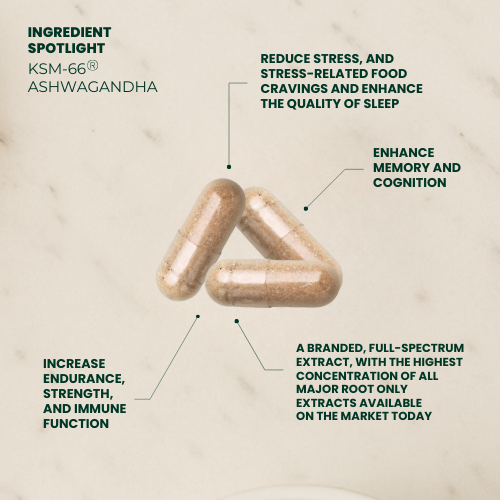
I started paying attention to the ingredients that support the body during sustained stress rather than just the symptoms that appeared at the end of it. Ashwagandha, which we now use in BRÍ Calm, has traditionally been used to support the body's response to stress. The research on KSM-66, the specific extract we use, is more substantive than most botanicals in this space, with multiple peer reviewed trials across cortisol, sleep quality, and sustained anxiety. B vitamins contribute to normal psychological function. Vitamin C contributes to normal immune system function. These are not dramatic interventions. They are conditions. The kind that support the body's ability to find its own way back.
And that is what the body wants to do, given half a chance. It wants to return to itself. It remembers what that felt like. It has not forgotten. It just needs the emergency to end long enough for the memory to surface.
An Balla is not a failure. It is information. The most important information your body has delivered in years. The question it is asking is not whether you can push through it. The question is what you are going to do differently now that you know.
If you recognise this territory, BRÍ Calm was made for the stretch before the wall, and for the return from it.
Mind yourself.
Glenn, Co-founder, BRÍ Wellness.