Inbox, Outbox, Burnout
I checked my email whilst actively having a conversation with Taylor about an idea she had for BRÍ. She noticed. I pretended I hadn't done it. We both knew. But that's modern life, right? Performing presence whilst being mentally elsewhere, and wondering why our stress levels never actually drop.
Here's the thing nobody tells you about being constantly available: your body doesn't care that you're just "quickly checking" something. It doesn't distinguish between a genuine workplace emergency and the seventeenth notification about someone replying-all to say "thanks." Every ping, every vibration, every instinctive reach for your phone triggers a stress response. And unlike our ancestors who faced actual life or death threats, our modern stressors never fully resolve. The inbox never empties. The threat never passes.
I learnt this the hard way. For years, I thrived (or believed I did) on workplace stress. Managing million-euro accounts meant being responsive, being sharp, being 'on'. I wore my stress tolerance like a badge of honour. Until one day, I was diagnosed with Ulcerative Colitis, and suddenly my body started keeping score in ways I couldn't ignore.
The Physiology of Being Permanently On Call.
When you're always available, your nervous system never fully stands down. It's like having a fire alarm that never quite switches off. It's just quietly chirping in the background, keeping you in a low-grade state of alert. This releases a natural hormone called cortisol. It is good, in small doses. But when chronically elevated cortisol becomes your baseline. Your body adapts to operating in survival mode, which sounds manageable until you realise that survival mode wasn't designed for sustainability. It was meant for short bursts. Get away from the predator, then rest and recover. Not check emails for twelve hours straight whilst pretending you're fine. Bairly sleep then wake up and do it all over again until the blissful light of retirement.
The problem compounds. Elevated cortisol disrupts sleep. Poor sleep impairs decision-making and emotional regulation. Impaired regulation makes every stressor feel more intense. More intense stress spikes cortisol higher. Round and round we go, wondering why we're exhausted despite doing nothing physically demanding.
For me, the score-keeping manifested in my gut.
During the discovery mission, I learned that stress directly affects gastrointestinal function through the gut-brain axis. When I'm checking emails compulsively, when I'm mentally rehearsing difficult conversations, when I'm performing availability despite needing rest, my gut inflammation flares. It's a very clear, very physical reminder that my body doesn't care how impressive my stress tolerance seems to others.
Why Irish Politeness Makes It Worse
In reflection, I believe there's a specific cultural flavour to this in Ireland that I don't think gets talked about enough. We're not great at saying no. We pride ourselves on being "sound", on not causing hassle, on being accommodating. Which means when someone emails at 9pm, we respond. When someone messages on Saturday, we engage. Because what if they think we're difficult? What if we're seen as not being team players?
The cost of Irish niceness is Irish bodies silently keeping score. We're burning out whilst smiling politely.
I'm still learning, i.e badly, inconsistently, imperfectly, how to set boundaries. Some days, I manage to close my laptop at 6pm and actually mean it. Other days, I'm refreshing emails whilst eating dinner, convincing myself it's just to "stay on top of things." Taylor has started pointing out when I'm physically present but mentally elsewhere. It's uncomfortable to notice. But noticing is the first step toward actually changing something.
What Actually Helps When You Can't Just "Switch Off"
Here's the reality: I can't restructure my entire work life overnight. I can't make my inbox magically empty itself. But we do have control. I learned that I can, and what I'm slowly learning to actually do, is support my body's ability to handle the stress I can't immediately eliminate.
I've found adaptogens have been genuinely helpful here.
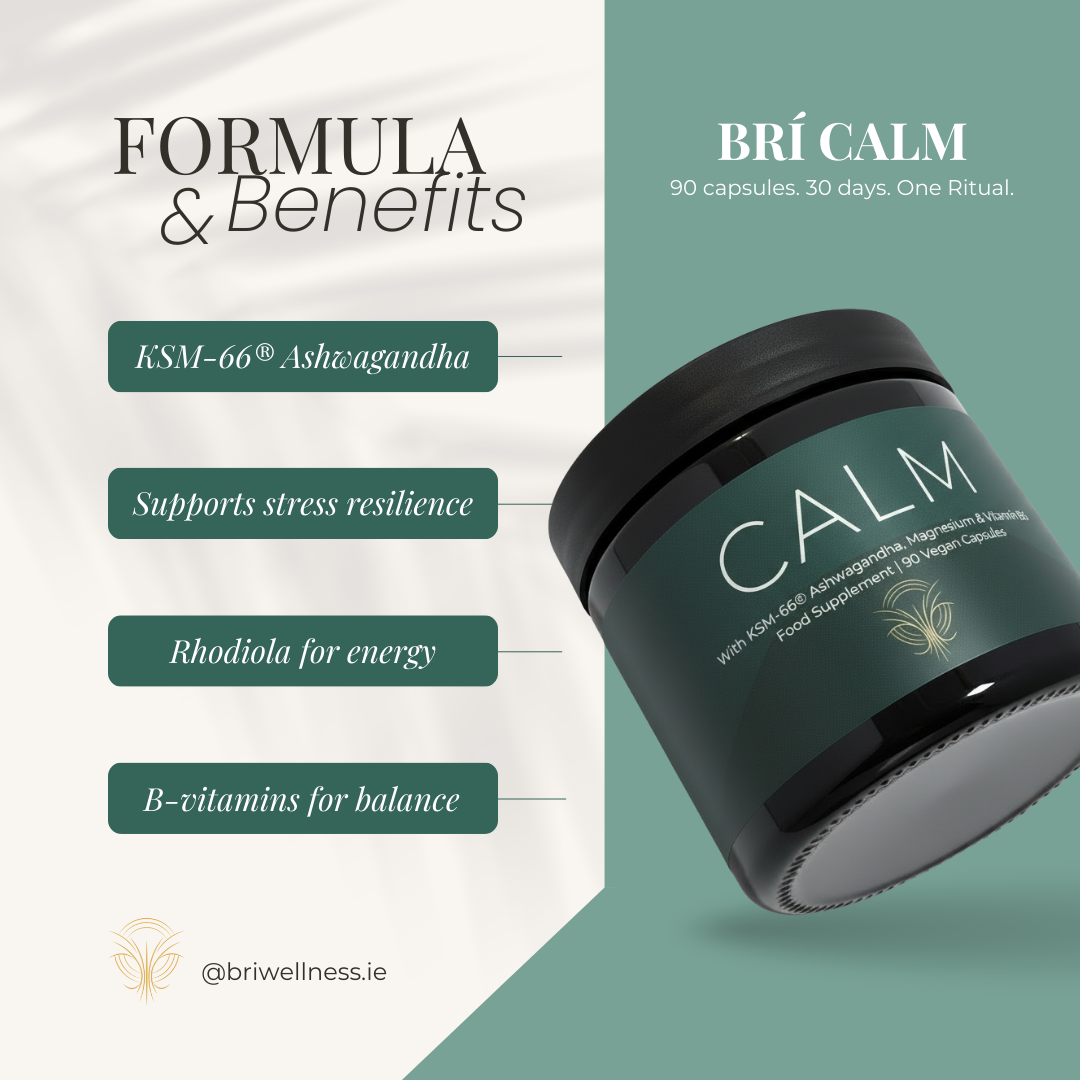
This is where the concept for our BRÍ Calm formula was born. Not in a "take a supplement and everything's fine" way, but in a "my nervous system has a bit more capacity to not spiral immediately" way. Ashwagandha (specifically the clinically studied KSM-66® form) has been shown to help modulate cortisol responses. It helps prevent the physiological cascade that leads to inflammation and sleepless nights. Rhodiola rosea works similarly, supporting the body's stress-response systems without sedating you into compliance.
L-Theanine, an amino acid found in green tea, promotes calm alertness without drowsiness. So tt's not really "switching off," it's more like turning down the volume on the constant background anxiety. And magnesium, particularly in the bisglycinate form, supports nervous system regulation and helps with that jittery, wired feeling that comes from being on high alert all day.
None of this replaces the need for actual boundaries. None of this fixes systemic workplace issues or makes constant availability healthy. But when you're doing your best with limited control, supporting your nervous system's resilience makes a tangible difference.
The Ongoing Work of Not Burning Out
I'm not a wellness success story. I still check my phone too much. I still catch myself mentally drafting emails during conversations. But I'm getting slightly better at noticing when I'm in a spiral before it becomes a full UC flare. That's the bar. Slightly better.
I've realised my gut is a more honest indicator of my stress levels than my brain is. My brain will convince me I'm fine, that I'm handling it, that I'm just being efficient. My gut tells me the truth: that constant availability is costing me something, even when I'm pretending it's not.
Some weeks are better than others. Some weeks I manage to keep work contained to work hours. The goal is recognising the pattern before my body stages a full rebellion.
If you're reading this whilst "just quickly checking" something, you already know what I'm talking about. Your body is keeping score too. The question is whether you're paying attention to what it's trying to tell you.